


“Languages, just like people, are worlds within themselves.”
– Orge Castellano.
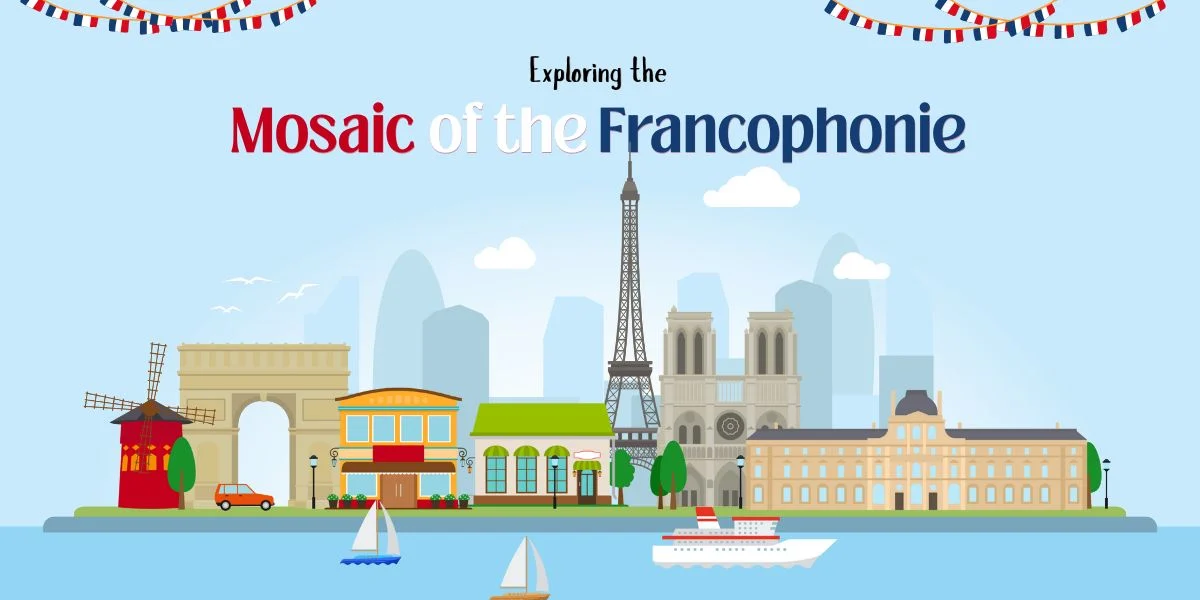
There is no denying the truth of this statement. A language has the incredible ability to provide us with a clearer, more profound and detailed perspective of a culture. As a speaker, nay, learner of the French language, I myself am witness to how learning this language has broadened my view of the world. When we think of French as a language, the image that immediately comes to mind is that of France with its tall standing Eiffel tower – but it is so much more – uniting more than 300 million people under the umbrella of the francophonie, a term which refers to individuals across five continents who share a common language – French – creating a vibrant global community united by a shared language.
The term ‘francophonie’ recognises the diversity of French speakers worldwide encouraging the preservation and the evolution of the language and its heritage. This term was first coined by the French geographer Onésime Reclus in 1880 and has since been used to describe the global network of French speaking countries and communities. It encompasses countries such as France (country of origin), Belgium, Switzerland and Canada. A lot of African countries such as the Ivory Coast, Senegal along with several others have French as their official language as they were colonised by France or Belgium for many many years. It is often said that the beauty of a language is in the way it molds itself to suit the place where it is spoken and the people who speak it. As a learner, it is imperative to know and understand the linguistic diversities that have evolved over the centuries due to historical, geographical and cultural factors.
Let us explore here a few of the French dialects to enhance the understanding of the complex dynamics shaping francophone communities worldwide.
1. Metropolitan French
Metropolitan French originates from the Parisian dialect. It serves as the standard variety used in education, media and formal contexts across France. Its influence extends globally through French literature, cinema and diplomacy.
2. Meridional French
Meridional French is spoken in the southern regions of France, including Provence, Languedoc and Gascony. It reflects influences from the Occitan language family known for its melodic intonation and rich cultural heritage.
3. Canadian French
Canadian French encompasses various regional dialects with Quebecois French being the most prominent and distinctive. It is characterized by a robust vocabulary that integrates English loanwords, Indigenous terms and regional slang.
4. Haitian French
Haitian French coexists with Haitian Creole in Haiti, reflecting the country’s complex history of colonization, slavery and cultural resilience. It incorporates Creole syntax and vocabulary into French structures.
5. North African French
North African French is prevalent in countries such as Algeria, Tunisia, Morocco and Egypt. It reflects influences from Arabic languages and cultures.
6. The Nouchi
Nouchi is a unique, hybridized urban slang or language originating in the cities of Côte d’Ivoire (Ivory Coast) around the 1980s. It blends French vocabulary with Ivorian languages and other slang, evolving from a lingua franca for uneducated urban youth into a significant marker of Ivorian identity used by people of all ages.
French is the language of love they say and that of diplomacy but its reach goes much beyond these boundaries. From the very formal language of the diplomats to the romantic language of the poets going on to the language of the streets used by the youth, the influence of the language is immense. Learn it at Kanakia International School – IB, not only as a foreign language but as a window into the world of such rich cultural diversity encompassing a multitude of cultures. Learn it for the simple pleasure of learning something new.